

Small Choices, Big Impact: The Environmental Cost of Mobile Design Decisions
Reflect upon the possible environmental impact of design choices in your app features and user interace design.

When we think about sustainability in technology, we often picture data centers, rare earth minerals, or the carbon footprint of shipping hardware across the globe. An app often feels weightless by comparison. An animation doesn’t look like pollution. A background refresh doesn’t feel like extraction. And yet, when those choices are multiplied across millions of devices, used for hours every day, they quietly accumulate into something far from negligible.
Mobile apps are among the most pervasive technologies we design today. In 2025, on average, people spend 4 hours and 43 minutes per day interacting with their mobile devices. This continuous relationship continues to grow. Apps mediate everyday life, communication, work, mobility and finances. They operate on short, repeated interactions with repetitive gestures at a high frequency.
This makes mobile apps especially powerful at shaping habits. A single interaction may be trivial, but repeated dozens or hundreds of times per day, it accumulates behavioural and environmental impact. Design choices, even if small, scale fast. Such as how often content refreshes, media auto-plays, how images are compressed, or whether dark mode is genuinely optimised. That’s why design decisions in mobile apps carry social, ethical, and environmental weight. Sustainability doesn’t begin with grand gestures or marketing ads; it begins with defaults.
Digital sustainability begins not in what the app encourages users to do, but in what the app itself consumes. Energy, data, hardware lifespans, and attention. The environmental footprint of a digital service is operational, continuous, and largely invisible, both to users and to the teams who build it.
Given the world we inhabit and the future we are shaping, sustainability cannot be ignored. It is often framed as a collective challenge, one that demands action from governments and corporations. Decisions from those who promote disproportionate environmental harm. While this framing is true, it hides another reality: apps shape everyday behaviour at an unprecedented scale. Deploying digital services is not neutral work. Small design decisions rarely announce themselves as environmental choices, yet at the scale of mobile platforms, their impact is anything but small.
Sustainability in and through design
Within interaction design research, there is a distinction between sustainability through design and sustainability in design.
Sustainability through design focuses on how interfaces encourage greener behaviours. This includes apps that encourage users to recycle, reduce energy use, or make more sustainable choices. Mobile apps can be effective here, particularly when they personalise feedback and make abstract goals feel tangible and relevant. Studies on recycling habits, gamification, and behavioural nudging demonstrate that well-designed systems can support meaningful change.
Sustainability in design questions how sustainable the artefact itself is. How much energy does it require to run, update, sync, and render? How much data does it move across networks? How much battery does it drain, and how often does that accelerate device replacement? In this context, many digital services quietly step back from responsibility.
The available sustainability standards support this blind spot. Scope 3 emissions reporting, for example, is a model structured around physical products, such as televisions, cars, phones, and appliances. The standard involves quantifying indirect greenhouse gas emissions that result from activities not directly controlled by the product but indirectly affected by it. Digital services do not fit into this model, nor any model yet, and emissions related to software distribution and usage are often treated as minor. Even global-scale companies claimed that downstream emissions from software usage are too small to matter. That assumption no longer holds with the scale of modern platforms.
For developers, this matters because performance, sustainability and user experience are deeply connected. Puffy interfaces, excessive animations, and constant background refresh do not just cost energy; they deteriorate user trust. They slow apps down, drain batteries, and frustrate users. Research has consistently shown that even a one-second delay in mobile load time can significantly affect engagement and retention. An app that feels heavy is rarely perceived as a good app, regardless of how polished it looks.
On Apple platforms, the relationship between design quality and resource efficiency is a bit clearer. iOS offers system-level tools –intelligent background task scheduling, caching mechanisms, system-wide dark mode, and detailed energy diagnostics through Xcode Instruments.
On OLED screens, dark and minimalist interfaces can significantly reduce battery consumption at higher brightness levels. This is because on OLED displays, black pixels are effectively turned off, meaning that a dark interface is not merely an aesthetic choice, but also an energy-saving decision. When multiplied across daily use by millions of people, these gains are not minor.
Seen through this lens, sustainable interaction design begins to resemble craft rather than compromise. For example, reducing the weight of images and videos improves load times and responsiveness. Deferring high-resolution assets until they are needed prevents interfaces from feeling bloated. Interfaces that prioritise simplicity can reduce cognitive load and make complex information more accessible. Flashy effects and high-resolution graphics may impress initially, but they also increase energy consumption and undermine sustainability goals. The challenge lies in creating experiences that are engaging without being wasteful. These decisions are not about doing less; they are about doing better.
Flashy effects and high-resolution graphics may impress initially, but they also increase energy consumption and undermine sustainability goals. The challenge lies in creating experiences that are engaging without being wasteful. These decisions are not about doing less; they are about doing better. Designers face a real tension between visual appeal and environmental responsibility.
What is often missing from this conversation is feedback. Designers and developers rarely see the environmental consequences of their decisions. We measure engagement, retention, and conversion with precision, yet energy use and cumulative impact over time remain largely uncalculated. The data exists. Correlating user behaviour, geographic distribution, and infrastructure load to understand how design changes ripple to the environment can be made by teams working on media-heavy services. Sustainability becomes actionable when we choose to observe it.
A critical lens
Sustainability can function as a critical lens rather than a vague aspiration. Research in sustainable interaction design highlights the need to define a system’s intent, scope, and long-term impact with clarity. What mechanisms does it rely on? What metrics define success, and over what timeframe? Without explicit framing, it is easy to focus on surface-level improvements rather than meaningful change. For example, optimising isolated parts of a system while quietly causing harm elsewhere.
Beyond technical aspects, sustainability also has an unavoidable social and ethical dimension. It is not only about energy efficiency or infrastructure optimisation, but about resisting design patterns that promote excess. Endless engagement loops and manipulative gamification may boost short-term metrics, leading to increased screen time, device usage, and cognitive strain. Designing responsibly sometimes means choosing less; recognising when not to engage is often the more sustainable decision.
Green AI
AI and machine learning are increasingly shaping UX and mobile design, including within sustainability-focused applications. When used thoughtfully, these systems can help optimise performance, personalise experiences, and reduce waste by anticipating user needs or minimising unnecessary interactions. In that sense, they can support more efficient and adaptive interfaces.
At the same time, they introduce new and often under-examined challenges. The ethical implications of training data –how it is sourced, represented, and governed– and the opacity of many training processes add significant layers of complexity. Generative systems, in particular, rely on energy-intensive computation, consume substantial amounts of electricity and water for cooling, and generate heat and hardware waste. They are relying on global infrastructures that are anything but immaterial. The human labour behind training data is rarely visible. Designing with AI requires acknowledging not only its interface-level benefits but also the environmental costs embedded deep within the systems themselves.
Designing products with AI means creating interfaces that are adaptive and dynamic –and this shifts the designer’s role. The focus moves away from crafting static screens toward defining rules, constraints, and values that shape how the screen behaves, adapting to human needs. Sustainability must be embedded at this foundational level. Otherwise, efficiency will always lose to short-term experimentation.
The encouraging reality is that none of this requires radical reinvention. It requires intention. Sustainability begins long before the first line of code is written, in how teams define success and articulate what “good” looks like. It continues in everyday decisions that rarely appear in case studies: whether an animation is necessary, whether an update can be deferred, whether personalisation serves the user or merely the metric.
A Sustainability Manifesto for Digital Services
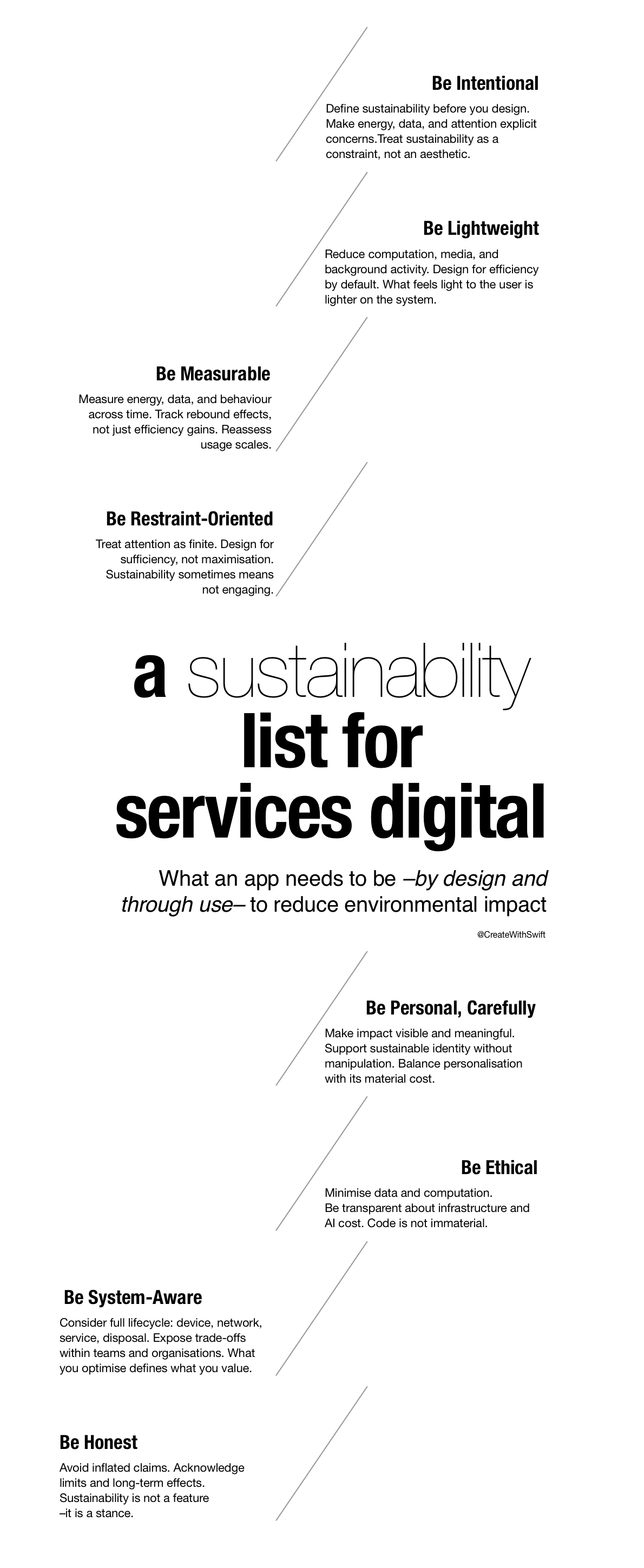
We shape the tools, and the tools shape us. Mobile apps are now among the most influential tools we build. Treating sustainability as a first-class design concern –alongside usability, accessibility, and performance– is no longer optional. Every small choice has an impact. The question is whether we choose to notice it and whether we design accordingly.
Sustainable mobile design is not about doing less. It is about acting deliberately, with the understanding that code is never neutral. Every interaction is an opportunity to respect both the person holding the device and the planet that supports the systems beneath it.
Sustainability in mobile design is not a feature to be added at the end of a roadmap, nor a virtue to be advertised in release notes. It is a stance. It asks us to see every animation, every refresh cycle, every model call, and every notification as part of a larger ecology of consequences. The scale of our platforms means that nothing we design remains small for long. If we accept that code shapes behaviour and behaviour shapes the world, then sustainability becomes inseparable from design itself. The future of mobile experiences will not be defined by how much they can do, but by how responsibly they choose to do it –with restraint, clarity, and an awareness that even the lightest interface leaves a trace.